
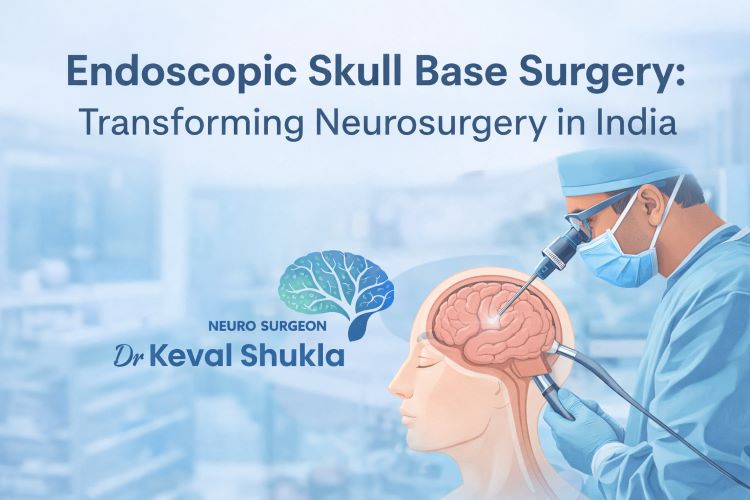
Neurosurgery has witnessed remarkable advancements over the last two decades, and one of the most revolutionary developments is Endoscopic Skull Base Surgery. This minimally invasive approach has dramatically changed how complex brain and skull base conditions are treated, especially in India.
Earlier, skull base surgeries required large incisions, prolonged hospital stays, and significant recovery time. Today, with endoscopic techniques, surgeons can access deep-seated brain areas with minimal disruption, leading to safer procedures and faster recovery. This evolution is transforming neurosurgical care across India and improving patient outcomes.
The skull base is the bony area at the bottom of the skull that separates the brain from structures such as:
Because of the density of critical structures in this region, even minor surgical errors can lead to serious complications. This made skull base surgery one of the most challenging areas in neurosurgery for decades.
Endoscopic skull base surgery is a minimally invasive technique that allows surgeons to reach deep areas of the skull base using an endoscope—a thin tube equipped with a high-definition camera and light source.
Instead of opening the skull, surgeons often access the skull base through natural pathways such as the nose and sinuses. This approach provides:
This technique is commonly referred to as endonasal endoscopic surgery.
Traditional skull base surgery typically involved open craniotomy, where a part of the skull is removed to reach the brain. While effective, this method had several limitations:
These challenges prompted the search for safer and less invasive alternatives, leading to the rise of endoscopic techniques.
Endoscopic skull base surgery has fundamentally altered neurosurgical practice in several ways:
Better Visualization
High-definition cameras provide magnified, panoramic views of complex anatomy, allowing surgeons to operate with exceptional precision.
Minimal Brain Manipulation
Since surgeons access the skull base without retracting the brain, the risk of neurological injury is significantly reduced.
Precision-Based Surgery
Advanced navigation systems guide surgeons in real time, enhancing safety in delicate regions.
Collaborative Surgical Approach
Endoscopic skull base procedures often involve both neurosurgeons and ENT (ear, nose, throat) specialists working together, improving surgical outcomes.
Endoscopic skull base surgery is used to treat a wide range of conditions, including:
Many of these conditions previously required major open surgeries but can now be treated with minimally invasive approaches.
Several innovations have accelerated the adoption of endoscopic skull base surgery in India:
High-Definition & 3D Endoscopy
Provides superior depth perception and clarity during surgery.
Neuronavigation Systems
Acts like a GPS for the brain, guiding surgeons safely through complex anatomy.
Intraoperative Imaging
Real-time imaging ensures accurate tumor removal and reduces recurrence.
Improved Surgical Instruments
Specialized micro-instruments designed for endoscopic use allow delicate tissue handling.
These advancements have helped Indian neurosurgical centers match global standards of care.
From a patient’s perspective, endoscopic skull base surgery offers several advantages:
Patients often experience quicker symptom relief and fewer complications compared to traditional surgery.
India has emerged as a significant hub for advanced neurosurgical care due to:
Major cities have seen rapid adoption of endoscopic skull base techniques, making advanced brain surgery accessible to a wider population. This growth has also positioned India as a destination for international patients seeking high-quality neurosurgical treatment.
Endoscopic skull base surgery requires specialized training and experience. Patients should look for:
Selecting the right surgical team plays a crucial role in ensuring safety and long-term success.
The future of endoscopic skull base surgery in India looks promising. Ongoing developments include:
As technology continues to evolve, these procedures are expected to become even safer, more precise, and widely available.
Endoscopic skull base surgery has transformed neurosurgery in India by offering a safer, minimally invasive alternative to traditional open brain surgery. With improved visualization, reduced complications, and faster recovery, this technique has redefined patient care for complex brain and skull base conditions.
As expertise and technology continue to grow, endoscopic skull base surgery is set to play an even bigger role in shaping the future of neurosurgery in India—bringing hope, safety, and better outcomes to patients nationwide.
